June 16, 2026
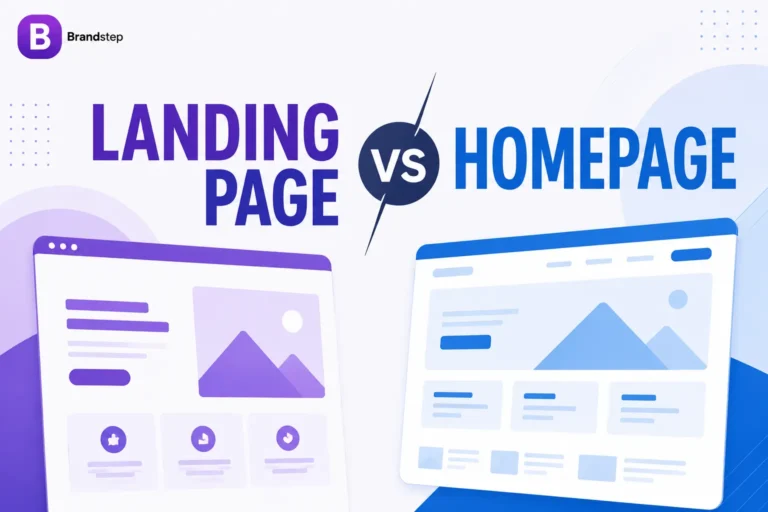
A common question people ask while building a website is whether they need a homepage or a landing page. The confusion is understandable because both are web pages, both can talk about your business and both can bring in customers. When you compare landing page vs homepage, the difference comes down to what you want your visitor to do after they arrive.
Someone searching for your business on Google might want to learn more about you. Someone clicking a Facebook ad for a festive sale probably wants details about that offer. Sending both people to the same page doesn’t always work.
The easiest way to understand a landing page is to think about online advertisements. You click an ad promising a free consultation or a discount and instead of reaching the main website, you arrive on a page built around that one offer.
That’s a website landing page.
The landing page meaning hasn’t really changed over the years. It’s simply the page where a visitor lands after clicking a marketing link. The page usually asks for one action. Fill out a form. Book an appointment. Buy a product. Download a guide.
You’ll notice that many landing pages don’t have dozens of menu options. That’s intentional. Fewer distractions often lead to better results.

If someone asks you to define homepage, don’t overcomplicate it. It’s the main page of a website and usually the first place people visit when they type in your web address.
So, what is home page? It’s where visitors get the bigger picture. They can read about the company, browse services, check reviews, read blogs and move to other sections of the site.
Think of it as a map. It doesn’t ask everyone to do the same thing. It helps different visitors find what they’re looking for.
This question trips people up.
Traditionally, what is the first page of a website called? The answer is the homepage.
But in digital marketing, the first page a visitor sees could be a landing page. If someone clicks on a Google Ad for “Luxury Apartments in Chennai”, they might skip the homepage altogether and land on a page created just for that campaign.
So the first page depends on how the visitor found your website.
Now that we’ve covered the basics, here’s a quick comparison to make the differences easier to understand.
|
Homepage |
Landing Page |
|
Gives visitors a complete picture of your business. |
Focuses on one specific product, service or campaign. |
|
Includes menus and links to different sections of the website. |
Keeps navigation limited to help visitors stay focused. |
|
Encourages users to explore and learn more about your brand. |
Encourages users to take one clear action. |
|
Best for building brand awareness and trust. |
Best for generating leads, sales or sign-ups. |
|
Caters to different types of visitors and their needs. |
Targets a particular audience or marketing goal. |
|
Can include several calls to action. |
Usually features one primary call to action. |
|
Acts as the main hub of your website. |
Often supports a specific advertisement or promotion. |
For most businesses, yes.
Your homepage helps people understand who you are. Your landing pages support individual products, services or promotions.
Imagine a dental clinic. The homepage explains treatments, introduces doctors and shares patient stories. A landing page might focus only on teeth whitening with a booking form and a limited-time offer.
Both pages have different jobs, and they work better together than they do separately.
No. A homepage gives an overview of your business. A landing page is created for a specific campaign or goal.
Yes. Many businesses create separate landing pages for different services, locations and promotions.
In most cases, yes. It helps visitors understand your brand and navigate the rest of your website.
Absolutely. If they click an advertisement or email campaign, they may go directly to a landing page.
A dedicated landing page usually performs better because it keeps visitors focused on one action instead of giving them too many choices.
Real business growth doesn’t come from simply having a website.
It comes from using the right page for the right goal.
A homepage is designed to inform, explore, and introduce your brand. A landing page is built to focus attention, drive action, and convert visitors into leads or customers.
Instead of sending every visitor to a generic homepage, businesses that use strategic landing pages often see better engagement, stronger conversion rates, and more measurable marketing results.
That’s where Brandstep helps.
Partner with Brandstep to build high-converting landing pages and user-focused websites that support your business goals. From strategy and design to conversion-focused execution, Brandstep creates digital experiences that attract the right audience and turn more visitors into customers.